
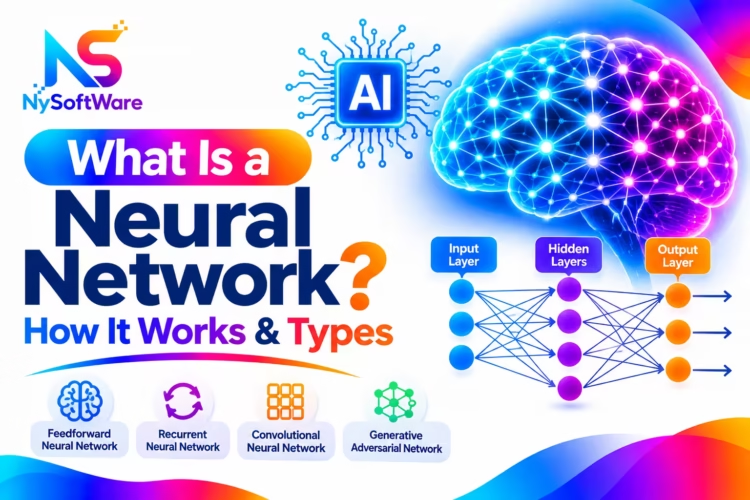
A neural network is a computer system that learns patterns from data. It loosely copies how brain cells pass signals to each other. Neural networks power photo tagging, voice assistants, fraud alerts, and AI image generators.
This guide from Nysoftware explains how neural networks work, the main types, and where you already use them. It is written for beginners in Plano, across the USA, and beyond.
What Is a Neural Network?
A neural network is a machine learning model made of connected nodes, called neurons, that find patterns in data. It learns from examples instead of following fixed rules.
An artificial neural network (ANN) is the formal name. Experts also call it a neural net.
Here is a simple example. You show the network 10,000 cat photos and 10,000 dog photos. It learns which features separate the two. Later, it can label a new photo it has never seen.
Neural Network vs. Machine Learning vs. Deep Learning vs. AI
These terms nest inside each other. AI is the biggest circle, and deep learning is the smallest.
| Term | Meaning | Relationship |
| Artificial intelligence | Machines that perform tasks needing human-like thinking | The broadest field |
| Machine learning | Systems that learn from data | A branch of AI |
| Neural network | A model built from layers of neurons | A tool within machine learning |
| Deep learning | Neural networks with many hidden layers | A subset of neural networks |
Why Do Neural Networks Matter?
Neural networks matter because they solve problems that are too messy for normal rules. Nobody can write a rule that describes every face, accent, or handwriting style. A neural network learns those patterns on its own.
They help with:
- Recognizing faces and objects in images
- Understanding speech and text
- Spotting fraud in banking
- Recommending shows, products, and songs
- Generating images, music, and text
In 2026, neural networks sit behind most consumer AI tools. Nysoftware explores this shift in its article on how AI software is changing technology.
How Does a Neural Network Work?
A neural network takes in data, processes it through layers, and outputs a prediction. It then checks its answer and adjusts to improve.
The Main Components of a Neural Network
Every network has the same basic building blocks:
- Input layer: Receives the raw data, such as pixels in an image.
- Hidden layers: Find patterns in the data. Deeper networks have more hidden layers.
- Output layer: Gives the final answer, such as “cat.”
- Neurons: Small units that take in numbers and pass on a result.
- Weights: Numbers that show how important each connection is.
- Biases: Extra numbers that help the neuron adjust its output.
- Activation function: A rule that decides whether a neuron should “fire.”
Weights and biases are the network’s parameters. A model’s parameters hold everything it has learned.
How Do Neural Networks Learn?
Neural networks learn by making guesses, measuring their mistakes, and correcting their weights. This cycle repeats thousands or millions of times.
- Forward pass: Data moves through the layers to make a prediction.
- Loss calculation: The network compares its guess to the right answer.
- Backpropagation: The network works backward and finds which weights caused the error.
- Weight update: An optimizer, such as gradient descent, nudges the weights to reduce the error.
- Repeat: The cycle runs again with new examples.
Backpropagation is the key idea behind most modern training. It tells each weight how much to change.
How Do Neural Networks Make Predictions?
After training, the network runs only the forward pass. It multiplies inputs by weights, adds biases, applies activation functions, and outputs a probability. For example, it may say “92% cat, 8% dog.”
For a deeper technical background, Wikipedia’s page on neural networks in machine learning covers the history and math.
Types of Neural Networks
The main types differ in how their layers connect and what data they handle best.
| Type | Best For | Simple Description |
| Feedforward (FNN) | Basic prediction and classification | Data moves one way, input to output |
| Convolutional (CNN) | Images and video | Scans images for edges, shapes, and objects |
| Recurrent (RNN) | Sequences like speech and time series | Remembers earlier inputs |
| Transformer | Language and many modern AI tasks | Weighs which words or parts matter most |
| Generative models | Creating images, audio, and text | Learns patterns, then makes new content |
What Is a Convolutional Neural Network?
A convolutional neural network is built to understand images. It uses small filters that scan a picture. Early layers find edges. Later layers find eyes, wheels, or faces. This is how phones recognize faces in photos.
What Is a Recurrent Neural Network?
A recurrent neural network handles data that comes in order. It keeps a short memory of what came before. That helps with speech, music, and stock data. Transformers have replaced RNNs in many language tasks since 2017.
Neural Networks in Image Generation
Image generators use neural networks to turn text prompts into pictures. Tools like Stable Diffusion store what they learned in a file called a checkpoint. Our guide on what a checkpoint is in AI image generation explains how that file controls style and quality.
Real-World Neural Network Examples
You use neural networks every day, often without noticing. Common examples include:
- Photo apps: Sort pictures by faces, pets, and places.
- Voice assistants: Turn speech into text and answer questions.
- Streaming and shopping: Recommend what you may want next.
- Banking: Flag unusual card activity.
- Healthcare: Help doctors read medical scans.
- Self-driving features: Detect lanes, signs, and pedestrians.
- Business software: Predict sales, sort support tickets, and score leads.
Businesses in Texas and across the USA also use neural networks in customer tools such as CRMs. See Nysoftware’s list of the best CRM software for small business for AI-powered options.
Advantages and Disadvantages of Neural Networks
Neural networks are powerful but not perfect. Know both sides before using one.
Advantages
- They find complex patterns that people miss.
- They improve as they see more data.
- They handle images, audio, and text.
- They scale to very large tasks.
Disadvantages
- They need large amounts of quality data.
- Training can cost time, money, and computing power.
- They often act like a “black box,” so their reasoning is hard to explain.
- They can copy bias found in training data.
Common Neural Network Problems and Mistakes
Most neural network failures come from poor data or poor training setup. Watch for these issues:
- Overfitting: The model memorizes training data and fails on new data.
- Underfitting: The model is too simple to learn the pattern.
- Biased data: Skewed examples produce unfair results.
- Too little data: The network cannot learn reliable patterns.
- Bad settings: A learning rate that is too high or too low slows or breaks training.
Beginners often ask which problems to expect first. This Quora search on neural networks shows real questions from learners and practitioners.
How to Get Started With Neural Networks
Start small, learn the basics, and build a simple project. A practical path:
- Learn basic Python.
- Study core ideas: layers, weights, loss, and backpropagation.
- Use beginner-friendly libraries such as TensorFlow, PyTorch, or Keras.
- Train a simple model, such as handwritten digit recognition with the MNIST dataset.
- Move on to image or text projects.
For business use, define one clear problem first. Then decide whether to build a model or use ready-made AI software.
Frequently Asked Questions
What is a neural network in simple words?
A neural network is a computer program that learns from examples. It passes data through connected layers of tiny units called neurons. Over time, it adjusts itself to make better predictions, such as recognizing faces, understanding speech, or recommending products.
How does a neural network learn?
A neural network learns by guessing, checking its error, and correcting itself. It makes a prediction, compares it to the right answer, then uses backpropagation to adjust its weights. After many rounds with lots of data, its predictions become more accurate.
What is the difference between a neural network and deep learning?
Deep learning is a type of neural network with many hidden layers. All deep learning uses neural networks, but not every neural network is deep. Simple networks with one or two hidden layers are not usually called deep learning.
What are the main types of neural networks?
The main types are feedforward, convolutional, recurrent, and transformer networks. Convolutional networks handle images. Recurrent networks and transformers handle sequences like text and speech. Generative models create new images, audio, or text.
What are neural networks used for in real life?
Neural networks power photo recognition, voice assistants, fraud detection, recommendations, medical imaging, and self-driving features. They also run AI image generators and chatbots. Many apps you use daily rely on them behind the scenes.
Do neural networks need a lot of data?
Usually, yes. Neural networks perform best with large, clean datasets. Small datasets often cause overfitting. Techniques like transfer learning let you reuse a pretrained network and fine-tune it with less data.
Conclusion
A neural network is a layered system that learns patterns from data by adjusting weights and biases. It powers many of the AI tools people use every day. Learn the core parts, know the main types, and watch for data problems, and you will understand how modern AI works.
Whether you are a learner in Plano or a business owner exploring AI across the USA, the right tools make adoption easier. Explore more AI guides and solutions at Nysoftware.
4 thoughts on “What Is a Neural Network? How It Works, Types, and Real-World Examples”