
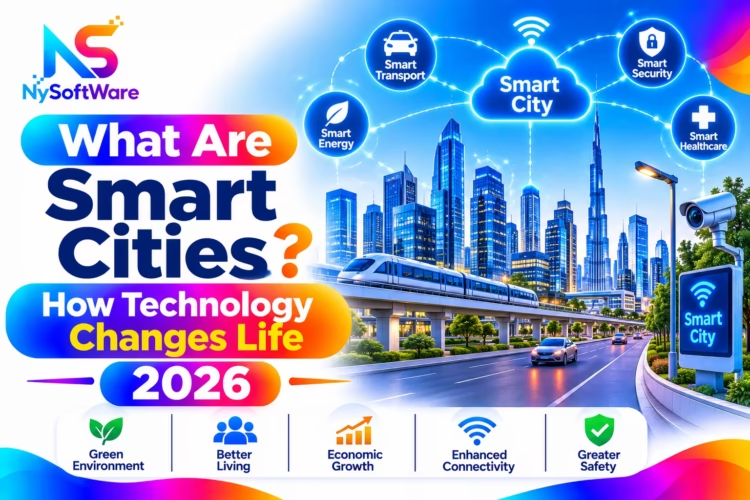
Smart cities are urban areas that use connected sensors, data, and artificial intelligence (AI) to run services better. They improve traffic flow, save energy, reduce waste, and make daily life safer and easier. A smart city does not just add gadgets. It uses technology to solve real city problems.
This guide from Nysoftware explains how smart cities work, shows real examples, and covers the benefits and challenges. It is written for readers in Plano, across Texas, and throughout the USA.
What Are Smart Cities?
A smart city is a city that collects data from connected devices and uses it to improve public services, sustainability, and quality of life. Sensors, cameras, apps, and analytics software work together to guide decisions.
A simple example: traffic sensors detect a jam, and the city changes signal timing to clear it. Drivers spend less time on the road, and the city saves fuel and reduces pollution.
Smart Cities vs. Traditional Cities
Traditional cities react to problems after they happen. Smart cities use real-time data to prevent or fix problems faster.
| Feature | Traditional City | Smart City |
| Traffic control | Fixed signal timing | Adaptive signals using live data |
| Street lighting | Always on | Dims or brightens as needed |
| Waste pickup | Fixed routes | Sensor-based, only when bins are full |
| Water systems | Leaks found after damage | Sensors detect leaks early |
| Decision making | Reports and surveys | Real-time data and analytics |
Why Do Smart Cities Matter?
Smart cities matter because urban areas keep growing, and old systems struggle to keep up. More people means more traffic, energy use, waste, and demand for services.
Smart technology helps cities solve:
- Traffic congestion and long commutes
- Rising energy costs
- Water loss from aging pipes
- Overflowing waste and poor recycling
- Public safety concerns
- Climate and sustainability goals
Nysoftware explores the technology behind this shift in its article on how AI software is changing technology.
How Do Smart Cities Work?
Smart cities work by collecting data, analyzing it, and acting on it. The process has four steps.
- Collect: Sensors, cameras, meters, and mobile apps gather data.
- Connect: Networks such as 5G, fiber, and Wi-Fi send that data to central platforms.
- Analyze: AI and data analytics find patterns and predict problems.
- Act: Systems adjust automatically, or city staff make better decisions.
The idea has a well-documented history in urban planning. Wikipedia’s page on the smart city explains how the concept developed.
Core Smart City Technologies
Five technologies power most smart city projects.
The Role of IoT in Smart Cities
The Internet of Things (IoT) is the network of connected sensors and devices that gather data. Examples include parking sensors, air quality monitors, and smart meters.
The Role of AI in Smart Cities
AI analyzes city data and predicts what will happen next. It can forecast traffic, spot unusual activity, and optimize energy use. Many of these systems rely on neural networks to recognize patterns in images and sensor data.
Big Data and Analytics
Cities generate huge amounts of data every day. Analytics tools turn it into clear insights for planners. See Nysoftware’s guide to AI tools for data analysis for tools that make this easier.
Connectivity
Fast, reliable networks, including 5G and fiber, connect devices and systems. Without strong connectivity, smart systems cannot share data in real time.
Cloud Computing and Cybersecurity
Cloud platforms store and process city data. Cybersecurity protects that data from attacks.
Smart City Applications in Daily Life
Smart city technology touches many parts of everyday life.
Smart Transportation and Traffic Management
Adaptive traffic signals, real-time transit apps, and smart parking reduce delays. Some cities also use connected systems for electric vehicle charging.
Smart Energy Management
Smart grids and smart meters balance power supply and demand. They help cities use more renewable energy and reduce waste.
Smart Waste and Water Management
Sensors in bins tell crews when pickup is needed. Water sensors detect leaks before they become costly breaks.
Smart Buildings
Smart buildings adjust lighting, heating, and cooling automatically. This lowers energy bills and improves comfort.
Public Safety and Security
Emergency response systems, connected cameras, and gunshot or incident detection tools help first responders act faster. Cities must balance these tools with privacy protections.
Digital Public Services
Residents can pay bills, request permits, and report problems through apps and online portals.
Smart City Examples Around the World
Several cities lead the way in smart city innovation.
- Singapore: Its Smart Nation program uses sensors and data for transit, housing, and services.
- Barcelona, Spain: Uses smart lighting, sensors, and open data platforms.
- Amsterdam, Netherlands: Runs pilot projects in energy, mobility, and circular economy.
- Dubai, UAE: Invests heavily in AI, digital government, and smart infrastructure. Learn more in Nysoftware’s article on artificial intelligence in UAE.
- Songdo, South Korea: A planned city built with connected systems from the start.
- Copenhagen, Denmark: Focuses on sustainability and carbon reduction.
Smart Cities in the USA
Many American cities, including cities in Texas, run smart city pilots. Common projects include smart traffic signals, connected public safety tools, and digital permit systems. Local efforts differ by city, so check your city’s official website for current projects.
Smart Cities in Developing Countries
India’s Smart Cities Mission aims to upgrade urban infrastructure in selected cities. In Pakistan, projects like the Safe City initiative in Lahore use connected cameras and command centers for public safety. Developing countries often focus on affordable, practical solutions such as transport, safety, and basic services.
Benefits of Smart Cities
The main benefit is a more efficient, safer, and more sustainable city. Other advantages include:
- Less congestion: Smarter traffic systems reduce delays.
- Energy savings: Smart grids and buildings cut waste.
- Cleaner environment: Better monitoring supports climate goals.
- Faster emergency response: Real-time data helps first responders.
- Lower costs over time: Early repairs prevent expensive failures.
- Better services: Residents get faster, easier access to city help.
Common Challenges and Mistakes
Smart cities face real obstacles, and honest planning matters. Common challenges include:
- Privacy concerns: Constant data collection raises questions about surveillance.
- Cybersecurity risks: Connected systems can become targets.
- High upfront costs: Sensors, networks, and software need investment.
- Unequal access: Some residents may lack internet or digital skills.
- Technology without a plan: Buying tools before defining problems wastes money.
- Data silos: Departments that do not share data limit results.
People often discuss these trade-offs online. This Quora search on smart cities shows common questions and opinions from residents and professionals.
How to Build a Smart City
Building a smart city starts with problems, not technology. Cities follow these steps.
- Define priorities. Choose issues such as traffic, safety, or energy.
- Build a roadmap. Plan projects by impact, cost, and timing.
- Invest in connectivity. Lay the network foundation first.
- Start with pilots. Test small projects and measure results.
- Protect data and privacy. Set clear rules for security and data use.
- Involve residents. Ask the public what they need.
- Scale what works. Expand successful pilots citywide.
Local businesses can also join in. Companies that track customers, services, or logistics benefit from the same data-driven thinking. Nysoftware reviews the best CRM software for small business for teams ready to use data better.
The Future of Smart Cities
Smart cities are moving toward more AI, cleaner energy, and stronger privacy rules. Expect growth in connected electric vehicle networks, AI-driven traffic and safety tools, and sustainability-focused planning. Cities that succeed will pair new technology with clear public trust and strong cybersecurity.
Frequently Asked Questions
What are smart cities in simple words?
Smart cities are cities that use connected devices, data, and AI to improve daily services. They manage traffic, energy, water, waste, and safety more efficiently. The goal is a cleaner, safer, and easier place to live and work.
How do smart cities work?
Smart cities collect data from sensors and devices, send it through networks, and analyze it with AI software. City systems then act on the results, such as adjusting traffic lights or sending crews to full waste bins. Staff use the insights to make better decisions.
What are examples of smart cities?
Well-known examples include Singapore, Barcelona, Amsterdam, Dubai, Copenhagen, and Songdo in South Korea. Each uses technology in different ways, from smart transit and lighting to digital government services and sustainability programs.
What technologies are used in smart cities?
Smart cities use IoT sensors, AI, big data analytics, cloud computing, 5G connectivity, and cybersecurity tools. These technologies work together to collect data, analyze it, and automate services such as traffic control, energy management, and public safety.
What are the benefits of smart cities?
Smart cities reduce congestion, save energy, improve safety, and lower long-term costs. They also support sustainability goals and give residents faster access to services. Real-time data helps city leaders respond to problems before they grow.
What are the challenges of smart cities?
The main challenges are privacy, cybersecurity, high startup costs, and unequal digital access. Poor planning can also waste money. Cities need clear data rules, strong security, and public involvement to build trust.
What is the role of AI in smart cities?
AI analyzes city data to predict problems and automate decisions. It helps manage traffic, forecast energy demand, detect unusual activity, and improve emergency response. AI makes city systems faster and more accurate.
Conclusion
Smart cities use connected technology and data to make urban life safer, cleaner, and more efficient. The best projects start with real city problems, protect privacy, and involve residents. Technology works best when it serves people.
Whether you live in Plano or follow urban innovation across the USA, understanding smart cities helps you see where cities are heading. Explore more AI and technology guides at Nysoftware.