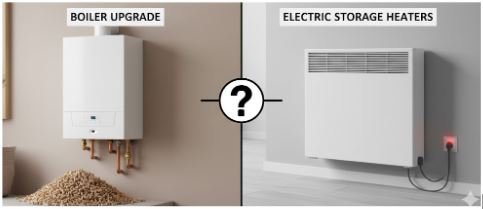

Many UK families continue to use electric storage heaters, commonly found in older apartment buildings and those that do not have access to gas. Many years ago, these units were considered a good alternative. Today, however, many individuals are now wondering about an important question:
Is a boiler upgrade the best option compared to electric storage heaters?
The answer will depend on your household, energy consumption, and what is offered through initiatives such as the Free Boiler Scheme or ECO4. The reason behind the differences, including costs, heating, and worth, is discussed in this very article. It will definitely help you understand what is best for your household.
How electric storage heaters work (and why many households struggle)
The storage electric heater uses electricity during off-peak times. This is mainly at night. The heat generated is stored in bricks. This heat is then released gradually throughout the day.
In theory, they function better if:
- The property is well-insulated
- The family utilises the Economy 7 tariffs appropriately
- Heating demand is predictable
In truth, many households are faced with challenges like:
- Heat resources are drying up by early evening
- Rooms are overheating during the day
- Inadequate control over temperature
- High electricity bills
Older-style storage heaters are particularly inefficient and leak the stored heat quickly, and are then left with expensive daylight rates and/or portable heating.
How a boiler-based heating system works
The boiler-based system, which could be gas-based, heats water on demand and distributes water through the radiators when the need arises. This enables the following:
- First, there is the instant heating that happens when the heating is turned on
- Consistency in warmth in the home
- Use of thermostats and timers in controlling temperatures
As gas is still relatively cheaper compared to electricity prices in the UK, boiler systems tend to be relatively cheap compared to electric systems, which is especially true for larger houses that require heating throughout the day and evening.
Running Costs: Boiler Upgrade vs Storage Heaters
| Feature | Boiler Upgrade (Gas Central Heating) | Electric Storage Heaters |
| Fuel type | Gas | Electricity |
| Average unit cost | Lower cost per kWh | Much higher cost per kWh |
| Estimated annual heating cost | £600 – £900 | £1,200 – £1,800 |
| Cost difference | — | £500 – £900 more per year |
| Heating control | On-demand, thermostat-controlled | Heat stored overnight, limited daytime control |
| Evening warmth | Reliable and consistent | Often runs out by evening |
| Need for extra heaters | Rare | Common (adds extra cost) |
| Impact of poor insulation | Moderate | High (stored heat lost quickly) |
| Suitability for all-day heating | Very suitable | Poor for evening-heavy use |
| Overall running cost | Lower and predictable | Higher and harder to manage |
Comfort and control: a major difference
Cost is a factor, but comfort is a consideration, too.
Storage heaters:
- Heat must be guessed the night before
- Limited control once charged
- Evening heat shortages are common
Boiler heating:
- Heat when you need it
- Easy temperature adjustments
- Even warmth across rooms
Seniors, families with children, and home office employees will particularly benefit from boiler systems since these offer a much more convenient way to heat their homes.
Installation and disruption: what to expect
Boiler upgrade
- Requires a gas connection
- Radiators and pipes could require repair
- Typically takes 1-3 days to finish
Storage heater upgrades
- Lesser disruption
- Electrical jobs only
- Still depends on electricity
While boiler upgrades involve more work upfront, the long-term benefits often outweigh the inconvenience.
Environmental and efficiency considerations
Modern boilers under ECO4 are:
- Highly rated in terms of efficiency
- Much cleaner than the old models
- Much more fuel-efficient
The older type of storage heaters, on the other hand:
- Waste stored heat
- Raise electricity demand
- Less efficient if poorly insulated
ECO4 is all about overall home efficiency, rather than simply replacing a furnace with another furnace.
What if your home does not have gas?
Obviously, not every house can change to a boiler system. In such situations, upgrading storage heaters will work best.
There may also be help available for some families through the “Electric Storage Heater Grant,” which can aid in the replacement of inefficient electric heaters with new, higher-efficiency ones. Although these systems are electric, they:
- Hold heat longer
- Offer better controls
- Waste less energy
How ECO4 helps households decide the best option
ECO4 is not a one-size-fits-all scheme. Assessments consider:
- Property type
- Heating system
- Insulation levels
- Household income
Those with access to gas may consider upgrading the boiler. They can get a free new A-rated boiler with up to 94% efficiency. For homes without gas, efficient electric upgrades combined with insulation may be recommended instead.
Long-term value: which is the better choice?
Boiler upgrade advantages:
- Lower annual heating bills
- Enhanced comfort and controllability
- Long lifespan (10-15 years)
- High value over time
Benefits for storage heater upgrades:
- Applicable for non-gas properties
- Reduced installation disruption
- Eligible for targeted grants
In most households that have gas supply lines, the most cost-effective and reliable source of heating is the boiler.
Free Boiler Upgrade Under the ECO4 Scheme
Under the ECO4 scheme, several households in the UK may be eligible for a free boiler grants, especially if they have a lower income or if they receive any benefits. The program is expected to maintain warm environments in households by installing new and efficient boilers in place of the old ones that consume more energy.
If you meet the required qualifications, the ECO4 boiler scheme typically covers:
- Removal of old, inefficient boiler
- Provision of a new A-rated condensing boiler
- Professional installation by certified engineers
- Basic heating controls for improved efficiency
In regard to eligible households, it implies that there will be no initial cost for the boiler and installation.
You qualify with a greater probability if:
- You claim Universal Credit, Pension Credit, or other benefits
- Your current boiler is old (pre-2005 installed) and non-condensing
- Your property has a low EPC rating (generally E, F, or G)
The process begins with a free eligibility check, and then the home survey will confirm eligibility. Once approved, the installation will be arranged at a convenient time. Nothing will be charged for checking eligibility, and there will be no obligation when not eligible.
In fact, if gas is available in your household, a boiler upgrade scheme that is completely free, under ECO4, can be the most effective method that reduce your heating bills.
Key takeaway: Is a boiler upgrade better?
In most homes in the UK, where gas is available, a condensing boiler is a far superior alternative to electric storage heating. It is cheaper to run, easier to control, and a far more comfortable means of heating, especially in mid-winter. H
owever, for those who do not have gas supplies at home, assistance from the ECO4 and other alternatives that include the Electric Storage Heater Grant will still help increase efficiency and lower heating bills. The answer depends on your house and needs.


