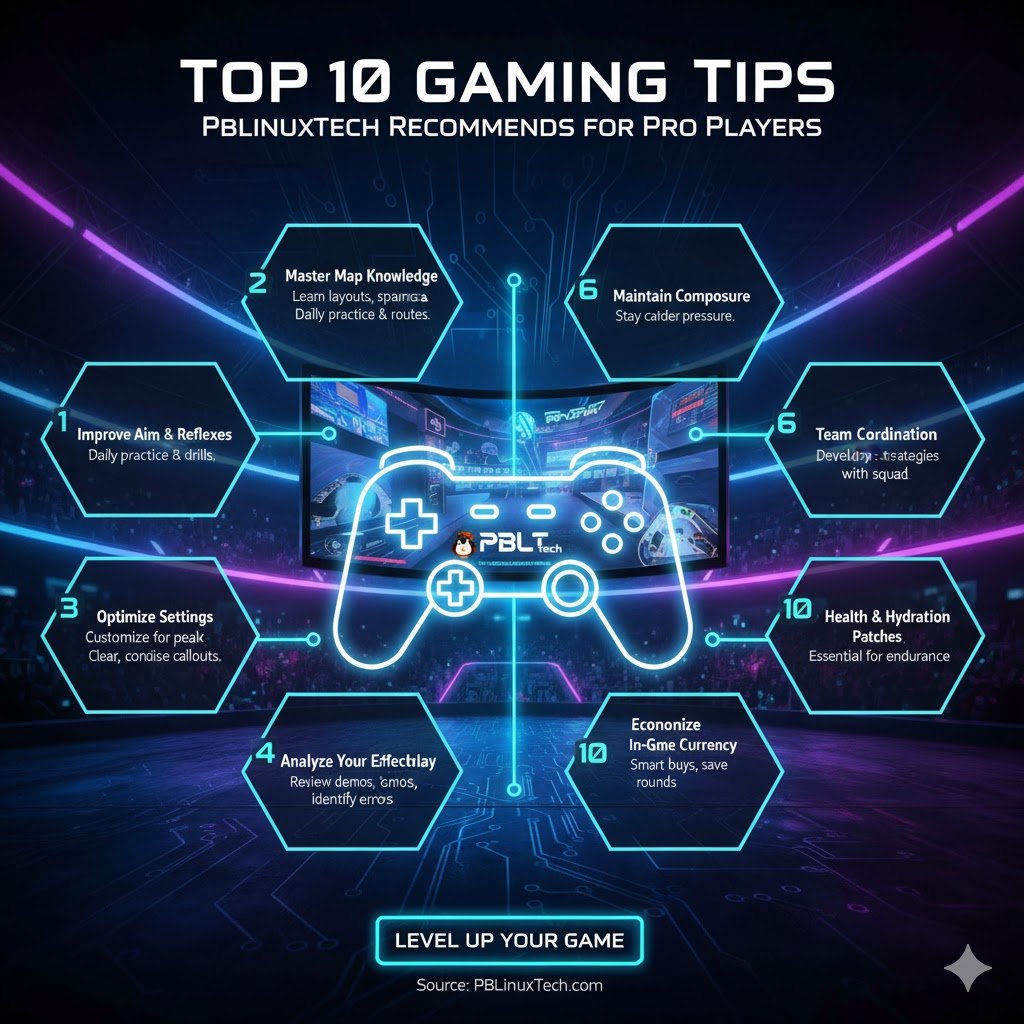

In the high-stakes arena of competitive gaming, the difference between victory and defeat is often measured in milliseconds and split-second decisions. While raw talent and countless hours of practice are the foundation of any great player, true mastery comes from optimizing every single aspect of your setup and mindset. For years, the team at PBLinuxTech has been dissecting the hardware, software, and strategies that give players an edge. We’ve compiled our most impactful findings into this essential guide. These are the top 10 gaming tips pblinuxtech consistently recommends for players looking to transition from good to truly great.
This collection of gaming tips pblinuxtech has been curated from deep-dive performance analysis and community feedback, focusing on changes that offer a tangible, immediate impact on your gameplay.
1. Master Your Input Lag Trinity: Mouse, Keyboard, and Monitor
Pro players don’t just play; they feel the game. A significant part of that “feel” is low input lag. This is the delay between your physical action and the game’s reaction.
Mouse: Disable any and all software acceleration or “enhance pointer precision.” You want raw, 1:1 input. Find a DPI (dots per inch) setting that feels natural—often between 400 and 1600—and then adjust your in-game sensitivity to achieve a comfortable cm/360 turn. Once you find it, stick with it to build muscle memory. This is one of the most fundamental gaming tips pblinuxtech analysts stress for competitive shooters.
Keyboard: If you’re using a mechanical keyboard, know your switches. Linear switches (like Cherry MX Red) are often preferred for fast, repeated key presses without a tactile bump.
Monitor: This is non-negotiable. A high-refresh-rate monitor (144Hz or, ideally, 240Hz+) is the single biggest hardware upgrade for a competitive player. Combine this with enabling the lowest possible response time setting (often called “Fast” or “Extreme”) and using a gaming-centric cable like DisplayPort to ensure you’re seeing the action as quickly as possible.
2. Optimize Your Network for Stability, Not Just Speed
A fast download speed is less important than a stable, low-latency connection. A single packet loss during a crucial fight can mean a lost round.
Use an Ethernet Cable: Ditch Wi-Fi. A wired Ethernet connection provides a more stable and reliable connection with consistently lower ping and zero packet loss.
Configure Your Router: Enable Quality of Service (QoS) settings on your router. This allows you to prioritize gaming traffic over other activities on your network, like streaming or downloads, ensuring your game gets the bandwidth it needs.
Scan for Interference: Use a Wi-Fi analyzer app to see if your channel is congested. Even on Ethernet, a congested Wi-Fi channel can impact overall router performance.
3. Create a Consistent Pre-Game Warm-Up Routine
Never jump straight into a ranked match cold. Your mind and muscles need to warm up.
Aim Trainers: Spend 15-30 minutes in an aim trainer like Aim Lab or Kovaak’s. Don’t just mindlessly shoot; focus on specific scenarios like flick shots, tracking, and target switching.
In-Game Drills: Use your game’s practice range or custom games to practice movement, recoil control, and ability usage. Make it a ritual. Consistency in your warm-up leads to consistency in your performance.
4. Develop Situational Awareness Through Sound
Vision is primary, but sound is your 360-degree radar. Pro players can often pinpoint an enemy’s location, weapon, and even their next action purely through audio cues.
Invest in Quality Audio: A good gaming headset with accurate spatial audio (like Dolby Atmos for Headphones or DTS Headphone:X) is crucial.
Adjust Your Mix: Lower the in-game music and maximize crucial sound effects like footsteps, reloads, and ability cues. Learning to filter audio information is a skill that separates amateurs from pros.
5. The Power of the VOD Review
You cannot fix what you do not see. Recording and reviewing your gameplay (VOD review) is one of the most powerful tools for improvement.
Watch Your Deaths: Every time you die, ask “Why?” Was it poor positioning? A missed shot? A tactical error? Be brutally honest with yourself.
Analyze Decision-Making: Don’t just watch the mechanics. Pause the VOD at key decision points and ask if there was a better rotation, a smarter engagement, or a more useful ability usage. This analytical approach is a core part of the improvement philosophy behind these gaming tips pblinuxtech advocates for.
6. Tame Your In-Game Settings for Maximum Clarity and Performance
Chasing hyper-realistic graphics can cost you frames and visual clarity.
FPS Over Fidelity: Lower your graphical settings until you achieve a stable frame rate that matches or exceeds your monitor’s refresh rate. A higher, stable FPS reduces perceived input lag.
Reduce Visual Noise: Turn off motion blur, depth of field, and film grain. These effects add visual clutter that can obscure enemies.
Find Your Color: Many pros increase digital vibrance or use color-blind modes (even if they aren’t color-blind) to make enemy models stand out more clearly against the environment.
7. Cultivate a Growth Mindset: Process Over Outcome
It’s easy to get tilted by a loss or a bad play. Pros focus on what they can control: their own performance and improvement.
Focus on the “How,” Not the “What”: Instead of being angry about losing a match, focus on how you lost it. Did you make good decisions? Did you hit your shots? If you played correctly but still lost, that’s a win for your long-term growth.
Take Breaks: Mental fatigue is real. Playing for 8 hours straight with diminishing returns is less effective than playing two focused 3-hour sessions. Get up, stretch, hydrate, and rest your eyes.
8. Master Communication: Be Concise and Informative
In team-based games, effective communication is a force multiplier.
Use Clear Callouts: Learn the official map callouts and use them. “One HP, behind boxes” is better than “He’s over there!”
Keep Comms Clean: Avoid clogging the voice channel with frustration or irrelevant chatter during a round. Save the post-game analysis for after the match.
9. Optimize Your Operating System for Gaming
Background processes can steal precious CPU cycles and introduce stutters. A clean and tuned OS is a pro’s secret weapon.
Disable Unnecessary Startup Programs: Use Task Manager to stop programs from launching at boot that you don’t need while gaming.
Adjust for Performance: In your OS settings, adjust for best performance over visual effects.
Update Your Drivers: Keep your graphics card drivers up to date, but be wary of “game-ready” drivers on day one; sometimes it’s better to wait a few days to see if they are stable. This final step in system optimization is a crucial piece of advice, and it’s a key part of the comprehensive gaming tips pblinuxtech provides for a seamless competitive experience.
10. Physical Health is a Performance Enhancer
Your body is your controller. Neglecting it will cap your skill ceiling.
Hydrate: Dehydration leads to fatigue and reduced cognitive function. Keep water at your desk.
Posture and Ergonomics: An ergonomic chair and desk setup prevent long-term injury and fatigue, allowing you to play comfortably for longer.
Sleep: This is the ultimate performance-enhancing drug. A well-rested brain has faster reaction times and better decision-making capabilities.
By methodically implementing these gaming tips pblinuxtech has outlined, you are not just changing settings; you are building the disciplined, optimized foundation of a professional player. Now, go claim your rank.
Frequently Asked Questions (FAQ)
Q1: I’ve applied these settings, but I’m not instantly better. Why?
These tips are designed to remove external barriers to performance (lag, clutter, instability). They give you the potential to play better, but they don’t replace the need for dedicated practice and building game sense. Improvement is a marathon, not a sprint.
Q2: Are these tips specific to a certain game?
While the examples are often from FPS titles, the core principles—managing input lag, optimizing networks, VOD review, mindset, and physical health—are universally applicable across almost all competitive genres, from MOBAs to battle royales.
Q3: How often should I be reviewing my VODs?
Aim to review at least one loss and one close win per gaming session. This gives you a balanced view of your mistakes and what you did well under pressure. You don’t need to review every single match.
Q4: Is overclocking my hardware necessary?
While it can provide a minor performance boost, it is not recommended for beginners as it can destabilize your system and cause crashes, which is worse than a few missing frames. Focus on software and settings optimization first.
Q5: What’s the single most important tip on this list?
If we had to choose one, it would be #7: Cultivate a Growth Mindset. Technical skill can be practiced, but without the mental fortitude to learn from losses and stay focused on long-term growth, you will inevitably hit a hard skill ceiling. Your mindset is the framework upon which all other skills are built.


Comments are closed.