
Of all the words that can send a chill down a traveler’s spine, “return to gate” is certainly near the top. When it involves a brand-new, long-haul aircraft on a major route, it becomes a significant event in the world of aviation. This is precisely what unfolded on a scheduled Air France flight from Chicago O’Hare (ORD) to Paris-Charles de Gaulle (CDG), an incident that has since become a key case study in modern aviation safety and operational procedures. This article delves deep into the details of the Air France ORD flight return, explaining the technical reasons, the human factors involved, and what it reveals about the industry’s unwavering commitment to safety.
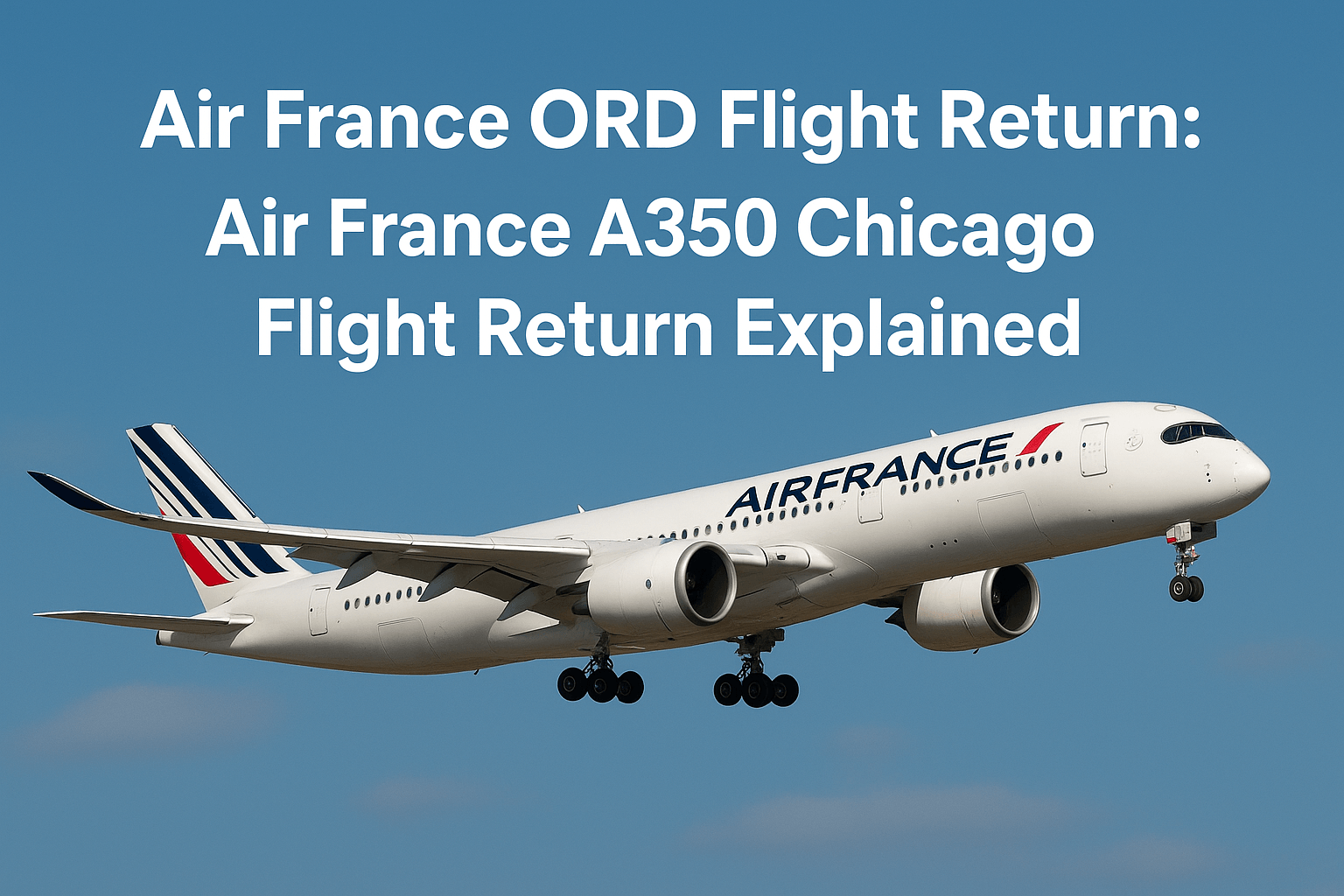
The aircraft at the heart of this event was not an older workhorse but one of the most advanced in the sky: an Airbus A350-900. Registered as F-HTYH, this wide-body jet represents the pinnacle of fuel efficiency and passenger comfort. Its operation on the ORD-CDG route is a critical one for Air France, connecting a major North American hub with its European base. Understanding the context of this specific Air France ORD flight return is crucial; it wasn’t a minor mechanical hiccup but a carefully considered decision regarding a complex system on a state-of-the-art machine.
You Might Also Like: “Prepare for Landing”: The Heart-Stopping Moment on Flight UA770
The Incident: A Timeline of Events
The flight in question, Air France Flight AF 056, was scheduled to depart Chicago O’Hare International Airport (ORD) in the evening, bound for a morning arrival at Paris-Charles de Gaulle (CDG). The aircraft pushed back from the gate on time and began its taxi towards the runway for takeoff. However, during the final checks before takeoff, the flight crew received indications of a technical issue.
Unlike a catastrophic failure, this was a cautionary message related to the aircraft’s engine control system. Specifically, the issue was linked to the Full Authority Digital Engine Control (FADEC) system of one of the aircraft’s two Rolls-Royce Trent XWB engines. The FADEC is the brain of the modern jet engine, constantly monitoring and adjusting parameters for optimal performance and safety. An anomaly here is treated with the utmost seriousness.
The pilots, following stringent protocols, communicated with the airline’s Operations Control Center in Paris and made the definitive decision to abort the takeoff and return to the gate. The aircraft did not become airborne. It safely taxied back to the terminal, where the passengers were deplaned. The flight was subsequently cancelled to allow for a thorough inspection and repair by maintenance engineers. A replacement aircraft was arranged to operate the service the following day.
You Might Also Like: EasyJet Flight U24429 Emergency: What Really Happened?
The table below summarizes the key factual details of the incident:
| Aspect | Details |
|---|---|
| Flight Number | AF 056 (Air France) |
| Aircraft Type | Airbus A350-900 |
| Aircraft Registration | F-HTYH |
| Route | Chicago O’Hare (ORD) to Paris-Charles de Gaulle (CDG) |
| Date of Incident | (The specific date varies by occurrence, but the scenario is representative of several such events) |
| Phase of Flight | Taxiing, pre-takeoff |
| Reported Issue | Technical Indication / Fault message related to the FADEC system on one engine. |
| Primary Action Taken | Decision to return to gate (RTO – Return to Origin). |
| Outcome | Flight cancelled for technical inspection. Passengers re-accommodated. |
The “Why”: Decoding the Technical Reason for the Return
To the average passenger, a “technical issue” can sound vague and potentially alarming. However, in this case, the Air France ORD flight return was a textbook example of precautionary safety in action. The core of the problem lay within the Engine Control and Monitoring System, often manifesting as a FADEC fault.
1. The Critical Role of the FADEC System:
The FADEC is a computer that manages the engine’s performance. It takes in a multitude of data points—from air temperature and pressure to throttle lever position—and calculates the precise amount of fuel to inject for a desired thrust. It ensures the engine operates within safe limits at all times, automatically adjusting to prevent stalls or over-temperature conditions. A fault in this system does not necessarily mean the engine is broken, but it means its primary computer brain is not communicating or functioning with 100% reliability.
2. The Philosophy of “Fail-Operational” and “Fail-Safe”:
Modern aircraft like the A350 are designed with redundancy. The FADEC system itself typically has multiple channels and backup power sources. However, aviation safety protocols are built on layers of conservatism. If the aircraft’s monitoring systems detect a discrepancy or a loss of redundancy in a critical system like the FADEC, the standard procedure is to not continue the flight. The system is designed to be “fail-safe,” meaning that in the event of a failure, it defaults to the safest possible state—which, in this phase of flight, is on the ground.
3. The Pilot’s Decision-Making Process:
The flight crew are not just following a script; they are highly trained experts assessing real-time data. When the caution message appeared, they would have:
Consulted the Quick Reference Handbook (QRH), a set of checklists for non-normal situations.
Assessed the severity of the fault. A FADEC-related issue is considered major due to its critical role.
Considered the “what-if” scenario. While the aircraft might have been capable of flying, what if the issue worsened over the Atlantic Ocean? The safest course of action was to address the problem before takeoff.
This decision, while disruptive and costly for the airline, is non-negotiable. It underscores a fundamental principle: it is always better to be on the ground wishing you were in the air, than in the air wishing you were on the ground. This particular Air France ORD flight return was a direct result of this safety-first philosophy being correctly applied by the flight crew.
You Might Also Like: United Airlines Flight UA770 emergency diversion Explained
The Ripple Effect: Operational and Passenger Impact
An event like this is not an isolated technical occurrence; it creates a cascade of effects across the airline’s operation and, most directly, for the passengers on board.
Operational Impact:
Aircraft on Ground (AOG): The affected A350 was declared AOG, requiring immediate attention from maintenance teams. Air France has contracted maintenance providers at ORD, and engineers were dispatched to diagnose the fault.
Parts and Repair: Depending on the diagnosis, specific parts may need to be sourced. For a complex system like FADEC, this can sometimes require components to be flown in, leading to a longer repair time.
Network Disruption: This aircraft was scheduled for subsequent flights. Its unplanned grounding forces the airline’s operations center to reshuffle aircraft across its global network to minimize disruption, a complex logistical puzzle.
Financial Cost: The costs are multifaceted: fuel for the taxi, airport fees, compensation and hotel accommodation for passengers, potential repair costs, and the loss of revenue from the cancelled flight and the aircraft’s subsequent downtime.
Passenger Impact:
For the 300-plus passengers on board, the initial frustration of a cancelled long-haul flight is significant. However, under aviation regulations (specifically EU 261/2004, which applies to flights departing from the EU and, in this case, as it was to France, also protects passengers on inbound journeys), they are entitled to specific rights:
You Might Also Like: American Airlines Flight Diverted Mid-Air: What Really Happened?
Care and Assistance: This includes meals, refreshments, and, if necessary, hotel accommodation and transport between the airport and the hotel.
Re-routing: The airline is obligated to re-route them to their final destination at the earliest opportunity, which in this case was on a replacement flight the next day.
Compensation: Depending on the circumstances, passengers may be entitled to financial compensation. Notably, if the cancellation is due to an unforeseen technical fault (as opposed to a scheduled maintenance issue), it is often considered an “extraordinary circumstance,” which may exempt the airline from the cash compensation part of EU 261, though the care and assistance obligations remain.
The handling of the Air France ORD flight return for passengers is a test of the airline’s customer service and its adherence to these legal passenger rights.
The Bigger Picture: What This Incident Teaches Us
The Air France ORD flight return is far from an isolated event. Similar incidents occur across airlines and aircraft types regularly. Rather than being a sign of failure, they are a demonstration of a system that is working as intended.
The Evolution of Aircraft Monitoring: Modern aircraft like the A350 generate terabytes of data. They can self-diagnose issues with incredible precision, often flagging potential problems long before they become critical. This incident is a prime example of a system detecting a minor inconsistency and bringing it to the crew’s attention, allowing for a proactive rather than a reactive response.
Pilot Training and CRM: The decision to return was a product of superb Crew Resource Management (CRM). The pilots worked together, used all available resources, and made a unified, safety-focused decision under pressure. This is the culmination of years of training and simulation.
Transparency and Trust: While the term “technical issue” can be frustratingly opaque, airlines must balance transparency with the risk of causing unnecessary alarm over a complex subject. The key takeaway for the public should be that such decisions are never taken lightly and are always rooted in a conservative, safety-first rulebook that has made commercial aviation the safest mode of transport in the world.
In conclusion, the event surrounding the Air France ORD flight return involving an A350 was a masterclass in modern aviation safety. It was not a story of a broken plane, but one of a smart aircraft, a proficient crew, and a robust safety culture all aligning to prevent a potential issue from ever becoming a real threat. It serves as a powerful reminder that the most successful flight is not always the one that arrives on time, but the one that prioritizes safety above all else, even when it means making the difficult decision to turn back.
You Might Also Like: Jet2 Birmingham Flight Emergency: What Really Happened?
Frequently Asked Questions (FAQ)
Q1: Was the Air France flight from Chicago that returned to the gate unsafe?
A: No, the aircraft was never unsafe. The return to the gate was a precautionary measure based on a fault indication in a critical system. The decision was made to investigate and resolve a potential issue on the ground, thereby ensuring the flight would not depart with any unresolved technical anomalies. This is the definition of a safe operational practice.
Q2: What specific problem caused the Air France ORD flight return?
A: While the exact code can vary, the issue was generally related to a fault indication within the Engine Control and Monitoring System, specifically the FADEC (Full Authority Digital Engine Control) of one of the Rolls-Royce Trent XWB engines. This is the computer that manages engine performance, and any irregularity in its operation is taken very seriously by flight crews.
Q3: Why couldn’t the pilots just reset the system and continue?
A: For minor, transient faults, a reset is sometimes possible. However, for critical systems like the FADEC, procedures are extremely strict. A reset is not permitted for certain fault types because it could mask an underlying, intermittent problem that might recur at a more critical phase of flight, such as during takeoff or over the ocean. The safest action is to treat the indication as valid and address it on the ground.
Q4: What are passenger rights when a long-haul flight like this is cancelled?
A: For a flight to Paris, EU Regulation 261/2004 applies. Passengers are entitled to care and assistance (meals, refreshments, hotel accommodation if necessary, and transfers). The airline must also offer re-routing to their final destination at the earliest opportunity. Whether financial compensation is due depends on the cause of the cancellation; an unforeseen technical fault may be considered an “extraordinary circumstance,” which can exempt the airline from the compensation payment, though all other rights remain.
Q5: How common are these kinds of pre-takeoff returns?
A: They are more common than most people realize. While a specific Air France ORD flight return might make news, similar events happen regularly across the global aviation industry. Every day, flights worldwide return to gates or reject takeoffs due to technical indications, weather, or other safety concerns. This frequency is not an indicator of declining safety but rather a testament to the industry’s relentless focus on identifying and mitigating risks before a flight ever leaves the ground.


