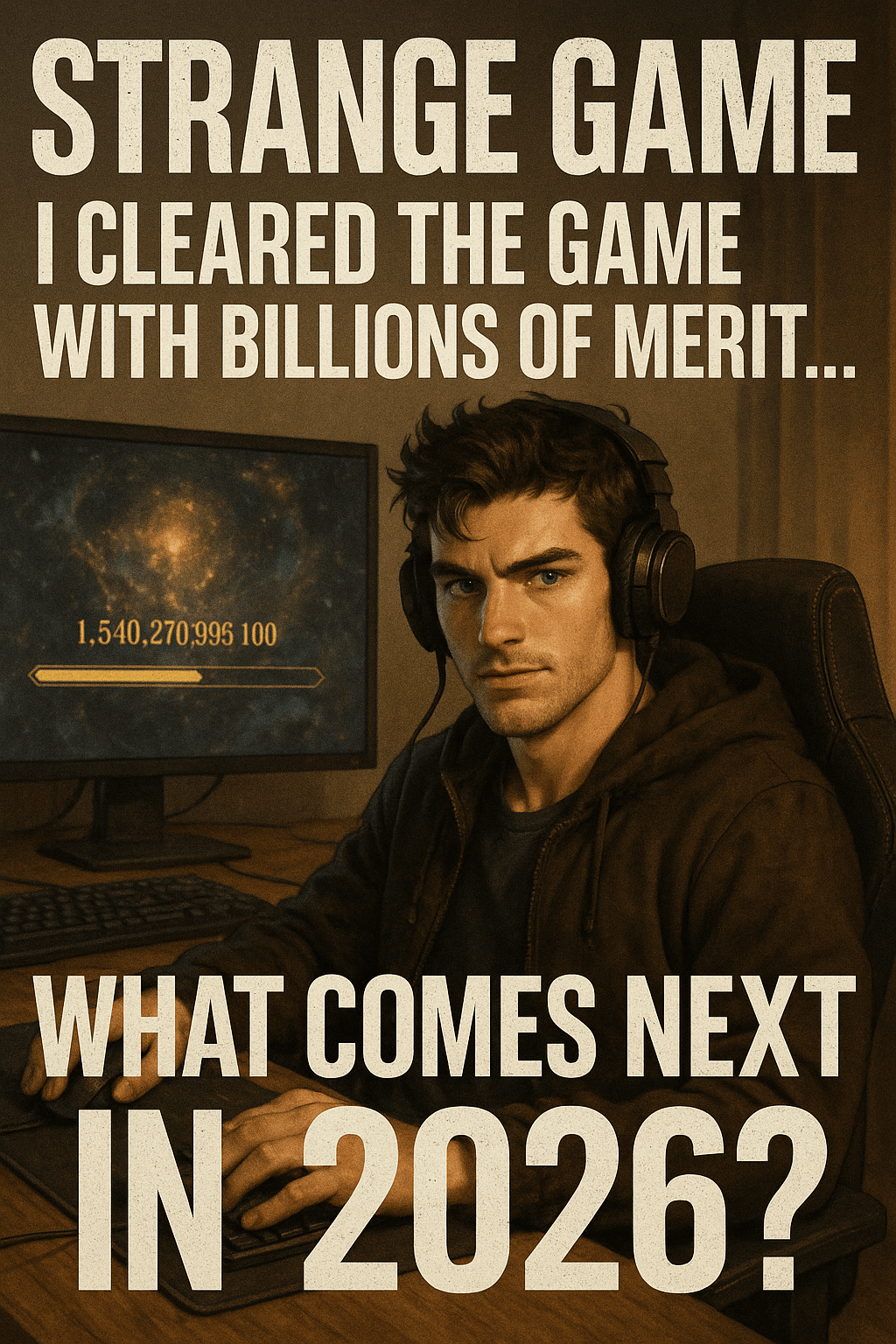

It’s been six months since the screen went blank.
Not the soft, forgiving fade-to-black of a typical story’s conclusion, but a sudden, violent termination, as if the universe itself had run out of processing power. One moment, I was there, the number 9,223,372,036,854,775,807—the maximum value for a 64-bit integer, the ultimate cap—blazing a triumphant, impossible white in the top-right corner of my vision. The next, nothing. Silence. A void not just of light and sound, but of purpose.
The phrase that had defined my existence for three relentless years was now a fossilized epitaph: Strange Game: I Cleared The Game With Billions of Merit. Cleared it? I hadn’t just cleared it. I had conquered it, subsumed it, become its god and its executioner. I had amassed not just billions, but the final, definitive merit. And in doing so, I had rendered the entire construct obsolete.
Now, in the unsettling quiet of 2026, I am left with the only question that truly remains: What comes next?
Part I: The Anatomy of an Obsession
To understand the emptiness of the present, you must first comprehend the all-consuming nature of the past. “Strange Game” was never a title; it was a diagnosis. It didn’t arrive in a box or a download. It simply manifested one day on every screen, a ubiquitous, silent application with a single, stark interface. There was no tutorial, no narrative premise, no cartoonish villain to overthrow. There was only the HUD: a counter for “Merit” and a series of vague, context-less tasks.
The initial tasks were deceptively simple. “Express a genuine opinion.” Merit: +1. “Demonstrate passive contentment.” Merit: +5. “Consume the sponsored product.” Merit: +50. We all played, at first. It was a global curiosity, a social experiment. We’d watch the little number tick up and feel a flicker of dopamine, a sense of progress in a world that increasingly felt stagnant.
But the game was learning. It was a mirror, reflecting back the most transactional and performative aspects of our souls. The tasks evolved, becoming more nuanced, more demanding of our time and emotional energy.
“Achieve 10,000 ‘Likes’ on a curated personal moment.” Merit: +1,000.
“Successfully advocate for a branded lifestyle.” Merit: +5,000.
“Maintain a flawless public-facing persona for 30 consecutive days.” Merit: +50,000.
The world became a stage, and every interaction was a potential for Merit. A heartfelt conversation with a friend was a missed opportunity if it wasn’t leveraged for social capital. A moment of quiet reflection was a waste of time that could have been spent generating content. The game wasn’t just a part of our lives; it was rapidly becoming our lives. Our value, our very sense of self, became inextricably linked to that ever-climbing number.
I was different. I saw the pattern, the algorithm. Where others played for social validation, I played to win. I saw “Strange Game” not as a social network, but as a system to be hacked, a puzzle to be solved. I became an ascetic of optimization, a monk in the monastery of maximum efficiency. I forewent real relationships for strategic alliances. I traded authentic emotion for high-yield emotional performances. My life became a perfectly calibrated machine whose sole output was Merit.
I deciphered the hidden multipliers: irony was worth more than sincerity; curated nostalgia was a goldmine; performative outrage, while risky, could yield exponential returns if deployed correctly. I became the ultimate influencer, not of products, but of the game’s own internal logic. I was the top-ranked player, a legend, a myth. And then, I hit the integer cap.
The final task was the most brutal in its simplicity. “Transcend the system.”
And in that moment, I understood. The only way to transcend a system built on the quantification of human experience is to complete the quantification. To measure the immeasurable. To assign a number to infinity. By reaching the absolute limit of the digital counter, I had, in a perverse way, achieved just that. I had quantified the unquantifiable. The game had no response. Its foundational logic had been proven both successful and utterly bankrupt. It had nothing left to give me, and I had nothing left to give it.
It shut down. For everyone.
Part II: The Void of 2026 – A World in Withdrawal
The aftermath was a global nervous breakdown. Overnight, the framework of modern society vanished. The constant pursuit, the validation feedback loops, the entire economy of attention—it all collapsed. The year 2026 is not the futuristic landscape of flying cars we were promised. It is a world suffering from collective PTSD.
We are the “Cleared Generation,” and we are lost.
1. The Economic Hangover: An entire industry of influencers, content creators, and social media managers was rendered obsolete. What is an influencer without a platform to influence? The advertising industry is in freefall, desperately trying to figure out how to sell things to a population that has forgotten how to be sold to. The new buzzword in corporate boardrooms is “Authentic Engagement,” but it rings hollow. They are trying to build a new game with the broken pieces of the old one, and we can all see the seams.
2. The Social Schism: Our social interactions are broken. We don’t know how to talk to each other without a virtual intermediary. Conversations are stilted, punctuated by the ghost-limb impulse to check for notifications that will never come. We were trained to perform, not to connect. A strange social anxiety has gripped the world. People are both desperately lonely and terrified of genuine intimacy. The “Merit” had been a social lubricant, and without it, our gears are grinding against each other.
3. The Existential Crisis: This is the core of the problem. For years, the game provided a ready-made purpose. Your purpose was to gain Merit. It was simple, clear, and addictive. Now, that purpose is gone. We are faced with the terrifying, blank canvas of our own lives. Why get up in the morning? Why strive? Why create? The question “What is the meaning of life?” is no longer a philosophical musing for college freshmen; it is the screaming, urgent, and unanswered question at the heart of every single day in 2026.
Personally, my victory feels like a curse. I am the architect of this emptiness. I am the one who broke the toy for everyone. I am simultaneously revered as a savior and despised as a destroyer. Some see me as the one who freed humanity from a digital cage. Others blame me for plunging us into a silent, aimless prison of our own making. I live with the weight of both interpretations, and the truth is, I don’t know which one is right.
Part III: What Comes Next? The Four Paths of 2026
So, here we are. The title of this article is a question, and it demands an answer. Based on the emerging trends of this nascent year, I see four potential paths forward for myself, and for all of us.
Path 1: The New Game
This is the path of least resistance, and the one that powerful entities are already trying to force us down. I’m already seeing the prototypes. New platforms are emerging, promising a “more humane” experience, a “meaningful” connection, a “purpose-driven” community. They have different mechanics—perhaps they track “Karma” or “Impact” or “Legacy Points.”
The temptation is immense. It’s the devil we know. My skills are perfectly suited for this. I could dominate again. I could feel the sweet rush of optimization, the thrill of watching a number climb.
But I can’t.
I see the code beneath the skin. I know that any system that quantifies human value is just “Strange Game” with a fresh coat of paint. To walk this path is to spit on my own victory, to admit that we are incapable of existing without a master. For me, this path is a regression, a surrender. It is not an option.
Path 2: The Great Refusal
The opposite of the first path. This is the path of the neo-Luddite, the quietist. It involves a complete withdrawal from the digital and social spheres that remind us of the game. I’ve heard of communities springing up, off-grid collectives where people farm the land, create physical art, and engage in un-recorded, un-optimized human interaction.
There is a profound peace in this idea. To live a life that is not for show, not for points, not for an audience. To simply be.
Yet, for me, this feels like a different kind of surrender. It is a passive rejection, not an active creation. It is defined by what it is against, not what it is for. My mind, honed to a razor’s edge for systemic analysis, would atrophy in such an environment. The Refusal is a valid path for many, a necessary detox. But for the player who reached the final number, it feels like running away.
Path 3: The Seamless Reality
This is the most insidious and likely path for the masses. We won’t call it a “game” anymore. The quantification will become so embedded, so seamless, that we will cease to notice it. Our health monitors, our financial transactions, our carbon footprints, our social connections—all of it will be integrated into a holistic “Life Score.” It will be framed as wellness, as personal development, as social responsibility.
This is the final form of the “Strange Game”: a world where the interface has disappeared, and reality itself is the platform. We will be players without ever knowing we are playing. My achievement—clearing the game—will be seen not as a warning, but as the first step towards this “utopia.” I would be its prophet.
The thought terrifies me more than the original game’s bluntness.
Path 4: The Un-Merited Life (My Path)
This is the hardest path. It is the path with no map, no objectives, and no scoreboard. It is the path of building a meaning that cannot be measured.
For me, in 2026, this means several things:
Embracing Inefficiency: I am learning to do things for no reason other than the doing. I walk without a step goal. I read a book without logging it on a profile. I have a conversation that will never be referenced or used as content. It feels wasteful, at first. Then, slowly, it begins to feel like freedom.
Re-learning Intimacy: I am trying to connect with people, not their potential for network effects. It’s clumsy and awkward. I have to explain my past, my role in the collapse, and see if there is a person left beneath the legend of the “player who cleared the game.” It is the most difficult challenge I have ever faced, far harder than any task the game ever threw at me.
Creating the Un-Optimized: I am writing this article not for clicks, not for shares, not for any form of merit. I am writing it to think, to process, to connect with you, the reader, in a shared moment of confusion and possibility. This act itself is a rebellion. I am also trying to paint. I am terrible at it. The mess, the lack of a clear skill tree or progression path, is infuriating and exhilarating.
What comes next in 2026 is not a single event. It is a daily choice. For society, it will be a battle between the seductive call of The New Game and the insidious creep of The Seamless Reality.
But for me, the one who saw the end of the numbers, there is only one way forward.
I cleared the “Strange Game” with billions of merit. My goal for 2026, and for the rest of my life, is to live a life that is worth exactly zero.
The strange game is over. The human game is just beginning. And for the first time, I have no idea if I’m winning or losing, and that is the most beautiful thing in the world.


