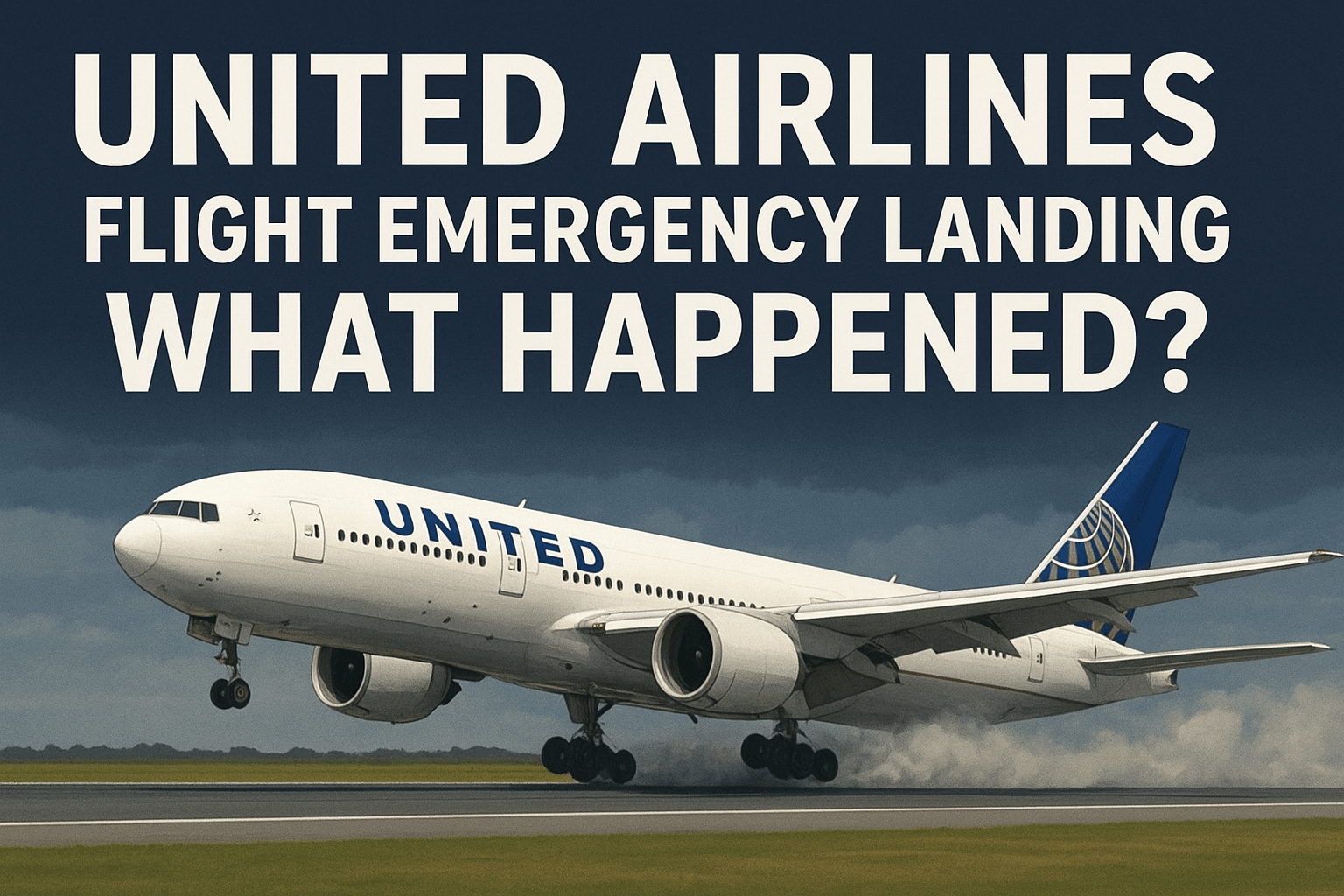

The phrase “emergency landing” strikes a chord of fear and uncertainty in the heart of every traveler. It represents a sudden rupture in the seamless experience of modern air travel, a reminder that behind the routine of boarding passes and overhead bins lies a complex, high-stakes operation where safety is paramount. Recently, an incident involving a United Airlines flight brought this reality to the forefront. Social media feeds and news alerts were abuzz with a terse, alarming headline: a United Airlines flight had executed an emergency landing. For the passengers on board, it was a journey from routine to alarm to profound relief. For the public, it sparked a wave of questions. The central, burning question was this: United Airlines flight emergency landing: what happened?
This article delves deep into the incident, piecing together the timeline from the first sign of trouble to the final sigh of relief on the tarmac. We will explore the technical aspects of the problem, the human element in the cockpit and cabin, the rigorous protocols that guided every action, and the aftermath that ensures such events contribute to the ever-evolving safety of aviation. The story of United Airlines Flight 3287 is not just a tale of a potential crisis; it is a masterclass in modern aviation safety in action.
You Might Also Like: “Prepare for Landing”: The Heart-Stopping Moment on Flight UA770
United Airlines Flight Emergency Landing: What Happened? – A Timeline of Events from Takeoff to Trouble
United Airlines Flight 3287 was a scheduled domestic service from Newark Liberty International Airport (EWR) to Miami International Airport (MIA). On a clear Tuesday afternoon, the Boeing 737-900, carrying 183 passengers and a crew of six, taxied and took off without incident. The climb-out was smooth, the seatbelt sign was turned off, and the cabin settled into the familiar hum of cruising altitude.
Approximately 90 minutes into the flight, as the aircraft was passing over the Carolinas, the routine was shattered. In the cockpit, the crew was alerted by a persistent master caution light. Accompanying it was a specific message on the Engine Indicating and Crew Alerting System (EICAS): “HYD SYS B PRESS LOW.” This warning indicated a critical issue: the pressure in the B hydraulic system was dropping precipitously.
In a modern aircraft like the 737, hydraulic systems are the lifeblood of flight control. They provide the necessary force to operate primary and secondary flight controls, including the ailerons, elevators, spoilers, and rudder. They also power critical components like the landing gear, brakes, and nose-wheel steering. Most aircraft are designed with multiple, redundant hydraulic systems (usually two or three) precisely for this scenario. The failure of one system is serious but manageable; the failure of a second can be catastrophic.
The pilots immediately began their drilled emergency procedures. The captain took control of the aircraft while the first officer began communicating and running checklists. The QRH (Quick Reference Handbook), a comprehensive guide for in-flight emergencies, was consulted. The steps for a “HYD SYS B FAILURE” are clear and methodical. The crew would have identified and isolated the failed system, confirmed which flight controls and systems were affected, and assessed the remaining capabilities of the A system.
Understanding the gravity of the situation, the captain made a decisive call. He instructed the first officer to declare an emergency with Air Traffic Control. The radio transmission was calm but unequivocal: “Mayday, Mayday, Mayday, United 3287, we are declaring an emergency due to a failure of our B hydraulic system. Request immediate vectors to the nearest suitable airport.“
The “nearest suitable airport” was not necessarily the closest strip of pavement. It needed to be an airport with a long enough runway, full emergency services, and adequate facilities to handle a wide-body jet and its passengers. Air Traffic Control quickly offered options, and the crew, in coordination with ATC, selected Charlotte Douglas International Airport (CLT). It was within a manageable distance and had the necessary infrastructure.
Back in the cabin, the mood shifted subtly at first. The flight attendants, tuned into the cockpit through the aircraft’s interphone system, had received a brief update. The senior flight attendant then made a calm but firm announcement. “Ladies and gentlemen, this is the lead flight attendant speaking. The captain has turned on the fasten seatbelt sign. We require all passengers to please return to your seats immediately and ensure your seatbelts are securely fastened. We are complying with a safety procedure and will have more information for you shortly.”
The professionalism of the cabin crew was the first layer of defense against panic. They began a visual check of the cabin, ensuring all passengers were seated, seatbelts were fastened, and carry-on items were properly stowed. They secured the galleys and prepared the cabin for a potential abnormal landing.
You Might Also Like: EasyJet Flight U24429 Emergency: What Really Happened?
United Airlines Flight Emergency Landing: What Happened? – The Calm in the Cockpit and the Precautionary Preparations
As the aircraft turned towards Charlotte, the cockpit workload was immense but controlled. The pilots were not just flying the plane; they were managing a complex problem. They ran through a series of checklists to confirm the extent of the failure. They verified that the landing gear could be extended using the alternate (often pneumatic or electric) systems, as the primary hydraulic method for the B system was compromised. They calculated a new landing weight. The aircraft was too heavy to land safely immediately after takeoff; the stress on the landing gear and brakes could be excessive. Therefore, they entered a holding pattern to burn off several thousand pounds of fuel, a standard procedure known as a “fuel dump” or, more accurately in this case, a fuel burn.
Meanwhile, at Charlotte Douglas International Airport, the emergency response was activated. The airport’s Aircraft Rescue and Fire Fighting (ARFF) vehicles were dispatched to strategic positions along the designated runway. Fire trucks, ambulances, and emergency personnel stood by, a vivid and sobering sight for anyone on the ground or looking out the aircraft’s windows. Their presence was a mandatory precaution, a testament to the aviation industry’s “what if” philosophy. The goal was to hope for the best but be prepared for the worst.
The captain came over the public address system to address the passengers directly. His voice, a model of calibrated calm, explained the situation without causing undue alarm. “Ladies and gentlemen, this is your captain speaking. We have experienced a minor technical issue with one of our backup hydraulic systems. While the aircraft is perfectly capable of flying and landing on the remaining system, in the interest of absolute caution, we have declared an emergency and will be landing in Charlotte shortly. You will see emergency vehicles on the runway when we approach; this is a standard procedure. Our flight attendants are highly trained for these situations, and please follow their instructions carefully. We expect a normal landing, but please brace for landing as instructed.”
This communication was critical. It was transparent, authoritative, and reassuring. It demystified the sight of fire trucks and set clear expectations.
The flight attendants then began the briefing for a “precautionary emergency landing.” They walked passengers through the brace position—leaning forward, head down, hands on the headrest in front—and reminded them of the location of the nearest exits. They instructed passengers to remove sharp objects from their pockets and high-heeled shoes. The cabin was silent, save for the voices of the crew and the low whine of the engines. The tension was palpable, a mixture of fear and focused attention.
You Might Also Like: United Airlines Flight UA770 emergency diversion Explained
United Airlines Flight Emergency Landing: What Happened? – The Landing and Aftermath
With the aircraft at a safe landing weight, the crew configured the aircraft for its final approach. The landing gear was extended successfully using the alternate system. The flaps were set. The pilots were relying on the remaining A hydraulic system for the majority of their flight controls. They knew that the braking power might be reduced, and the nose-wheel steering might be inoperative, meaning they would have to use differential engine thrust and rudder to steer after touchdown.
As the runway threshold approached, all eyes on the ground were fixed on the United jet. The approach was stable, the descent rate normal. The main gear touched down smoothly on the centerline. Reverse thrust was deployed. The pilots reported that the brakes were functional but required more pedal pressure than usual. As the aircraft slowed, the loss of nose-wheel steering became apparent, but the crew used careful differential braking and rudder inputs to keep the aircraft on the centerline. It was a text-book example of expert airmanship.
Once the aircraft came to a full and safe stop on the runway, a collective wave of relief washed over the cabin. Spontaneous applause broke out, a traditional and heartfelt tribute to the crew that had just ensured their safety. The captain came back on the intercom: “Ladies and gentlemen, welcome to Charlotte. The time is 4:32 PM. We have safely landed, and all emergency vehicles are standing by as a precaution. Please remain seated until we have been towed to the gate and it is safe to disembark.”
Since the aircraft could not taxi under its own power, a tug was dispatched to tow it to a gate. Upon arrival at the gate, passengers disembarked normally via the jet bridge, greeted by United Airlines customer service agents who were already on hand with rebooking options, meal vouchers, and hotel accommodations for the night. The aircraft, however, was going nowhere. It was immediately taken out of service and cordoned off for a thorough investigation by United’s maintenance team and, subsequently, by officials from the Federal Aviation Administration (FAA) and the National Transportation Safety Board (NTSB).
United Airlines Flight Emergency Landing: What Happened? – The Investigation and Broader Implications
The post-incident investigation focused on a single question: what caused the B hydraulic system to fail? Maintenance teams began a forensic examination of the entire system. The culprit was soon identified: a ruptured hydraulic line near the rear of the aircraft. The rupture was likely caused by fatigue and vibration over thousands of flight cycles, which had created a microscopic crack that eventually gave way under pressure.
The implications were immediate. United Airlines, in coordination with the FAA, likely issued a directive for enhanced inspections of hydraulic lines on its fleet of 737-900 aircraft. This “teardown” and inspection process is a core tenet of aviation safety—every incident, even those with a successful outcome, is a learning opportunity that leads to improved maintenance protocols and, ultimately, safer skies for everyone.
The story of United Airlines Flight 3287’s emergency landing is not a story of disaster. It is a story of success. It is a powerful demonstration of how decades of safety culture, redundant engineering, and relentless training come together to manage a serious in-flight failure. From the cool-headed pilots executing their procedures, to the professional cabin crew managing passenger anxiety, to the ground teams responding with precision, every link in the safety chain held strong. The question, “United Airlines flight emergency landing: what happened?” finds its answer not in a tale of catastrophe, but in a resounding affirmation of why modern air travel is the safest mode of transportation in history.
You Might Also Like: American Airlines Flight Diverted Mid-Air: What Really Happened?
United Airlines Flight Emergency Landing: Incident Summary Table
| Aspect | Details |
|---|---|
| Flight Number | UA 3287 |
| Aircraft Type | Boeing 737-900 |
| Route | Newark (EWR) → Miami (MIA) |
| Diverted To | Charlotte Douglas Intl. Airport (CLT) |
| Primary Cause | Failure of the B hydraulic system due to a ruptured hydraulic line. |
| In-Flight Action | Crew declared an emergency, followed checklists, burned fuel to reach safe landing weight, and configured aircraft using alternate systems. |
| Landing | Successful precautionary landing using the remaining A hydraulic system. Aircraft towed to the gate. |
| Injuries | None. All passengers and crew disembarked safely. |
| Aftermath | Aircraft taken out of service for inspection. Passengers rebooked and provided accommodations. |
| Key Takeaway | The incident demonstrated effective crew resource management, robust aircraft redundancy, and successful execution of safety protocols. |
Frequently Asked Questions (FAQ)
Q1: What was the specific mechanical problem that caused the emergency?
A: The emergency was triggered by a failure in the aircraft’s B hydraulic system. The root cause was identified as a ruptured hydraulic line, which led to a rapid loss of hydraulic pressure. This system is critical for operating several flight controls, landing gear, and brakes, necessitating the precautionary landing.
Q2: Was the plane in any real danger of crashing?
A: While any loss of a major aircraft system is serious, the risk of a crash was extremely low. Modern aircraft like the Boeing 737 are designed with multiple, redundant systems for this exact reason. The pilots retained control using the fully functional A hydraulic system. The emergency declaration and precautionary measures were taken to ensure the highest possible margin of safety.
Q3: Why did the plane circle before landing? Why not land immediately?
A: The aircraft was too heavy to land safely immediately after takeoff. Landing at a weight above the maximum structural landing weight could cause severe damage to the landing gear and airframe. The crew entered a holding pattern to burn off fuel until the aircraft reached a safe landing weight.
Q4: I’m a nervous flyer. How can I trust that this won’t happen on my flight?
A: This incident should actually build trust, not diminish it. It is a powerful real-world example of the safety nets built into every flight. The systems detected a problem, the redundant backups worked, the highly trained crew managed the situation perfectly, and the aircraft landed safely. The industry will now use this event to make the fleet even safer through improved inspections.
Q5: What compensation are passengers entitled to after an emergency landing?
A: This varies by circumstance and airline policy. In a situation like this, where the landing is precautionary and not due to an airline fault (like a maintenance oversight), airlines are not legally required to provide compensation beyond rebooking and basic care. However, as a customer service gesture, United Airlines provided passengers with meal vouchers, hotel accommodations, and rebooking on the next available flights. In cases where an airline is found at fault, more significant compensation may be offered.
Q6: Who investigates these kinds of incidents?
A: Multiple entities are involved. The airline’s own safety and maintenance departments conduct the initial investigation. In the United States, the Federal Aviation Administration (FAA) oversees the regulatory compliance aspect. For more serious incidents, the National Transportation Safety Board (NTSB) may launch an investigation to determine the probable cause and issue safety recommendations to the entire industry.


