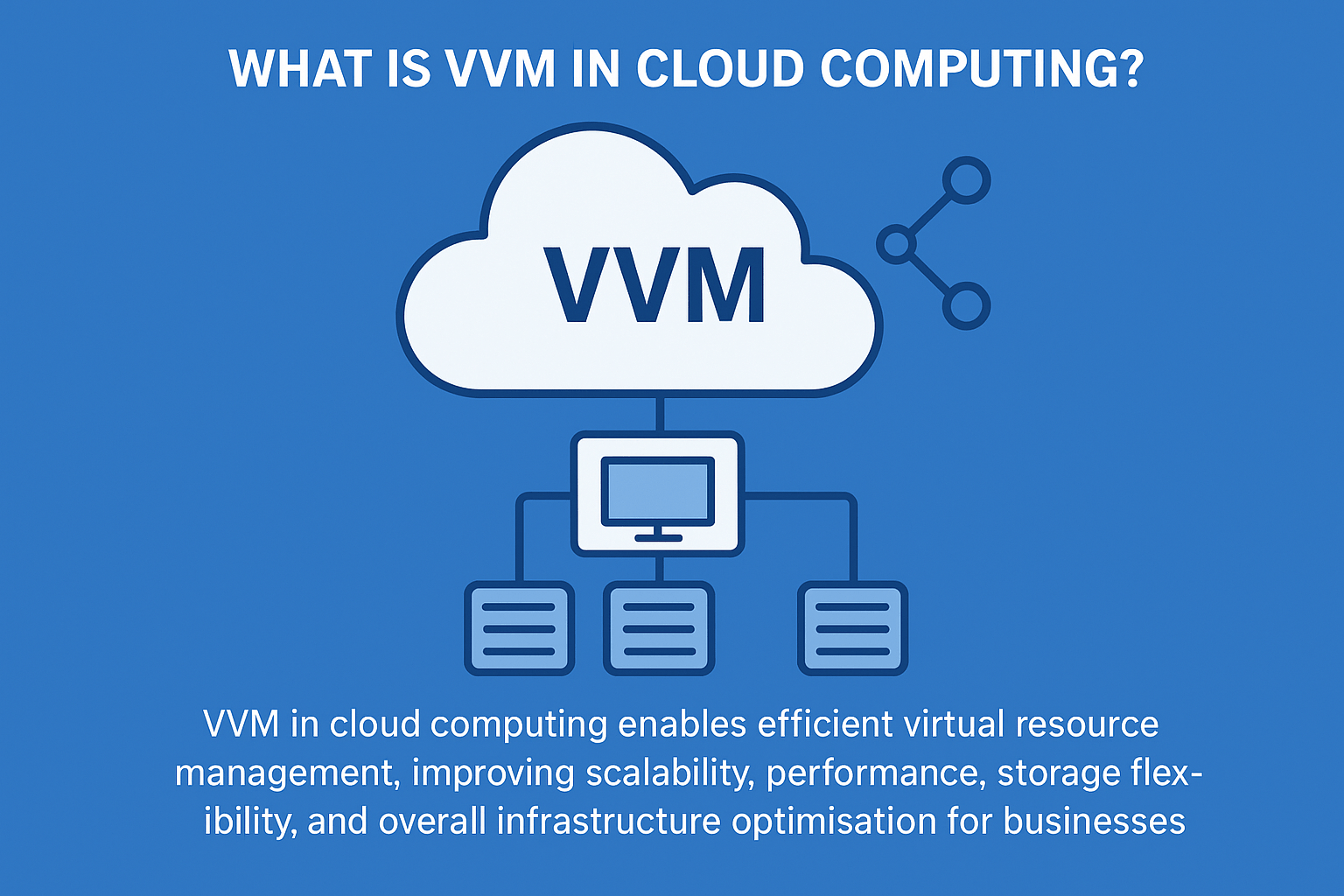

In cloud computing, VVM commonly refers to a Virtual Volume Manager or Virtual Virtual Machine layer that works alongside traditional virtualization technologies. Its main role is to manage virtual storage and machine-level resources more intelligently and dynamically.
Instead of tying storage or computing power directly to specific hardware, this approach allows resources to be created, modified, moved, or resized virtually. This is extremely important in cloud environments, where speed and agility are key.
With the support of VVM, organization’s can:
Create new virtual machines in minutes
Expand or reduce storage without hardware changes
Increase system reliability through redundancy
Improve overall performance and disaster recovery capabilities
This makes cloud architectures more adaptable and resilient.
You Might Also Like: PodVM: Everything You Need to Know
How VVM Works in a Cloud Environment
To understand how VVM operates, imagine a large data center filled with physical servers. Normally, each server has fixed storage and processing power. But in a modern cloud, these hardware limits are hidden behind virtual layers.
VVM sits between the hardware and the virtual machines. It performs several key tasks:
Abstracting physical resources – It converts physical storage and hardware into flexible virtual components.
Allocating resources dynamically – It distributes memory, storage, and computing power based on real-time demand.
Managing performance – It balances the load to prevent slowdowns or system crashes.
Supporting automation – It allows cloud platforms to scale applications automatically when traffic increases.
All of this happens in real time, without the end user noticing any change.
Key Features of VVM in Cloud Computing
There are several features that make VVM a vital part of modern cloud architecture:
1. Dynamic Resource Allocation
Instead of assigning fixed resources, the system adjusts them as needed. This prevents waste and improves efficiency.
2. Scalability
You can easily scale up or down depending on workload demands. This is ideal for websites and applications that experience fluctuating traffic.
3. High Availability
If one physical component fails, VVM can quickly shift operations to another part of the infrastructure, reducing downtime.
4. Improved Storage Management
It groups and organizes virtual storage, making it easier to back up, restore, and monitor data.
5. Cost Efficiency
By maximizing the use of hardware, companies can reduce their overall infrastructure spending.
These benefits explain why more organization’s rely on virtual volume and machine management technologies.
Why VVM Is Important for Businesses
The growth of cloud-based services means that businesses must manage more data and workloads than ever before. VVM is important because it provides a reliable and intelligent framework for handling this increased demand.
Here are some key business advantages:
Faster deployment – Applications and services can be launched quickly.
Better performance – Resources are optimized for peak efficiency.
Reduced downtime – Failover mechanisms keep systems running.
Lower operational costs – Less physical hardware is required.
Improved security – Isolation between virtual environments offers extra protection.
For startups, enterprises, and IT service providers, these benefits translate into better productivity and stronger system reliability.
VVM vs Traditional Volume Management
Traditional volume management ties storage directly to physical disks. If a company outgrows its system, it must add new hardware and reconfigure the entire structure. This can be expensive and time-consuming.
On the other hand, VVM removes this limitation by working at the virtual level. Storage and machine capacity can be increased virtually without reconfiguring physical devices.
Key differences include:
| Traditional Management | VVM-Based Management |
|---|---|
| Fixed physical storage | Flexible virtual storage |
| Limited scalability | Easy horizontal/vertical scaling |
| Manual configuration | Highly automated |
| Higher maintenance | Lower maintenance |
| Hardware dependent | Hardware independent |
This is why cloud-first companies prefer virtual systems over older methods.
Real-World Use Cases of VVM
To understand its practical importance, let’s look at some real scenarios where VVM is widely used:
1. E-commerce Websites
Online stores need to handle huge traffic spikes during sales. Virtual management ensures smooth performance without crashing.
2. SaaS Applications
Software-as-a-Service platforms rely on quick provisioning and storage adjustment, enabled by virtual resource layers.
3. Data Backup and Recovery
Cloud backup services store massive amounts of data. Virtual volume systems make restoring files quicker and easier.
4. Development and Testing Environments
Developers create and destroy multiple testing environments daily. Virtual management helps automate these tasks effortlessly.
These use cases clearly show how valuable this technology is in today’s digital world.
Challenges Associated With VVM
Despite its advantages, VVM also comes with certain challenges:
Complex configuration – Requires proper planning and skilled professionals.
Monitoring issues – Virtual layers can be harder to track compared to physical systems.
Performance tuning – Needs careful management to avoid over-allocation.
Security risks – Misconfigured settings can expose vulnerabilities.
However, most of these challenges can be addressed with right tools, planning, and expertise.
The Future of VVM in Cloud Computing
The future of VVM is strongly connected with trends like Artificial Intelligence, Edge Computing, and Multi-Cloud Environments. As workloads become more demanding, this technology will continue to evolve to support:
AI-driven automation
Self-healing infrastructure
Smarter resource predictions
Greater integration with containers and Kubernetes
Enhanced cross-platform compatibility
In short, it will continue to play a big role in shaping how modern digital systems function.
Conclusion
In cloud computing, VVM is a powerful component that enhances the way virtual machines and storage resources are managed. It offers automation, scalability, efficiency, and flexibility, all of which are essential in modern IT environments.
By allowing systems to operate beyond the limits of physical hardware, it helps organizations deliver better performance, reduce costs, and stay competitive in a fast-changing digital landscape. Whether used in small businesses or large enterprises, it provides a foundation for reliable, future-ready cloud architecture.
Understanding and implementing it correctly can make a significant difference in both system performance and operational success.
Frequently Asked Questions (FAQs)
1. What is VVM in simple terms?
It is a virtual system that manages and organises storage and machine resources within a cloud environment.
2. Is VVM the same as a virtual machine?
No. A virtual machine is an individual unit, while VVM is a management layer that controls and organises multiple virtual elements.
3. Do small businesses need VVM?
Yes. It helps reduce costs, improve performance, and scale systems as the business grows.
4. Is VVM used in public clouds like AWS and Azure?
Yes, many cloud platforms use similar technologies to manage virtual volumes and machines behind the scenes.
5. Does VVM improve security?
It can improve isolation and backup processes, but security still depends on proper configuration and monitoring.
6. Is it difficult to implement?
It requires technical knowledge, but most cloud providers offer built-in tools and automation to make implementation easier.
7. Can VVM work with containers?
Yes, modern systems integrate it with container platforms such as Kubernetes for better orchestration and storage control.
8. What is the main benefit of VVM?
The biggest benefit is flexibility – the ability to scale and manage resources without being limited by physical hardware.
9. Does it affect performance?
When configured correctly, it improves performance by optimising resource use.
10. Is VVM the future of cloud infrastructure?
Yes, it is a key part of next-generation cloud architectures due to its adaptability and efficiency.


